Zach's Study Log

Ok, I have never made one of these but I’m gonna try it out. I just came back from a long hiatus where I did not use vacation mode, so I am slowly working through my 123903240928 reviews. Here is the current state of my dashboard
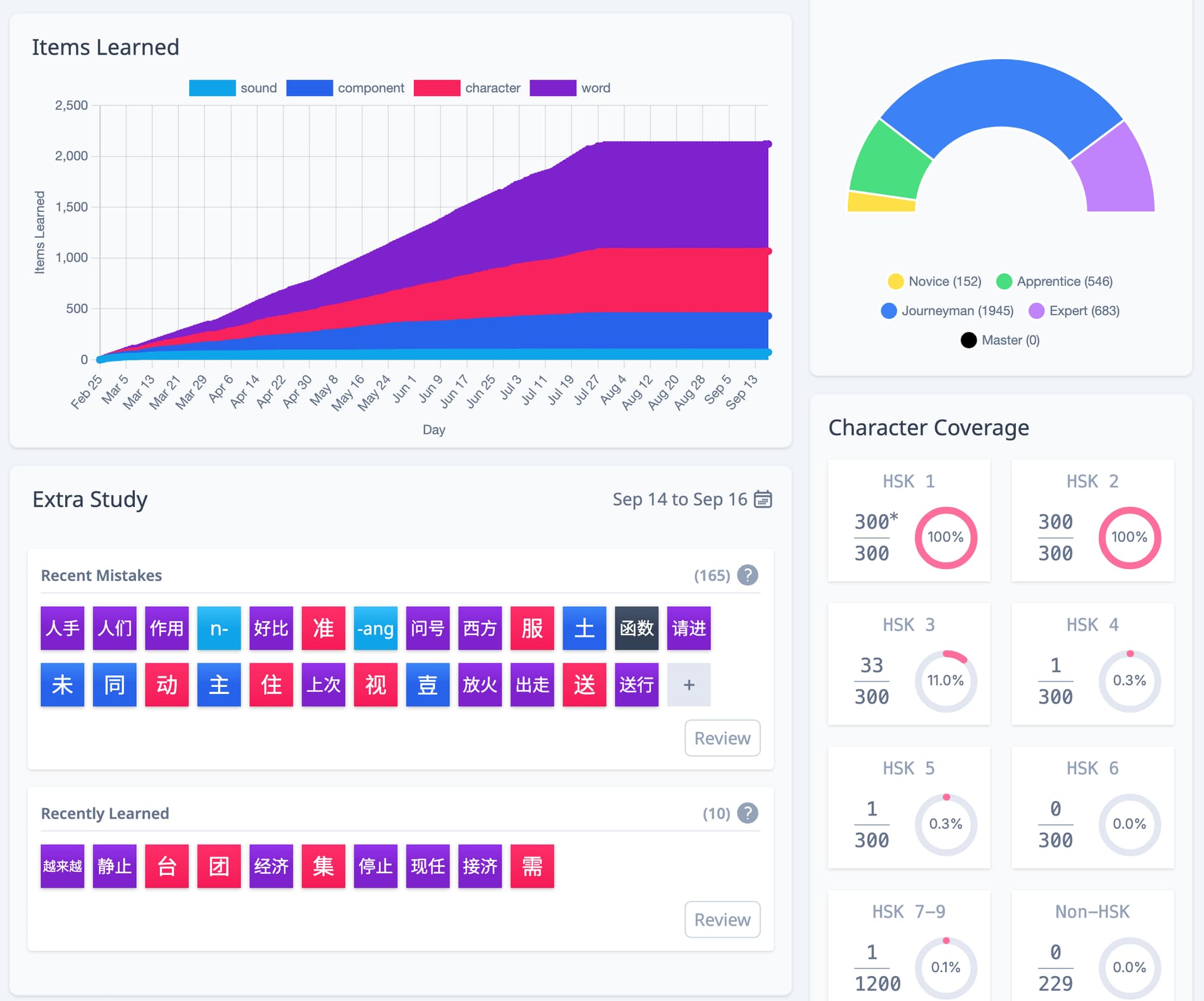
I thought that the little things I was doing with Hanzi Hero every day weren’t really helping and I didn’t feel like I was making any sort of meaningful progress, but if you just look at the plot you can see that that is obviously wrong. In hindsight I should have just kept me new lessons per day to about 5 or so, so that I could at least carry on a little something. Just look at how much progress I lost.

I always found it difficult to get the mnemonics to really stick, so this time I’m trying a slightly different route. I made a PureRef file compiling a bunch of different images from all of the actors and locations in the Hanzi Hero method, and I have been keeping it open when I read the mnemonics so that I can zoom in on the hi-res images and really immerse myself in the scene. For the words, I feel like I remember them better if I connect the pronunciation of the words with the meaning, instead of the meanings of the individual characters with the meaning of the word, so I made a spreadsheet which I add new words I learned every day. I have been asking Chinese AI for help creating mnemonics to connect the pronunciation with the meaning, and I have been recording them there for reference when I am going through reviews, until they become second-nature. Whenever I get stuck with the mnemonic visualization I ask an AI to help generate an image for me to reference (I know the ethics there are a little muddy but it is really helping me out), so that I can build my visualization skills from there.

Reviews are very difficult since I was never that good at visualizing the mnemonics but with the techniques I outlined above and a little extra patience, they are coming back to me too.

I was really unsatisfied with the pace I was learning the material, and I thought there should be some way to “hack” my way into learning the characters faster, but after my break I realized that it really is quality of quantity. It doesn’t matter how many characters you learn per day if you don’t really understand them.

Hanzi Hero has been my primary character and word learning application, and I have been using Migaku and Notebook LM for sentence mining in order to get real-world practical experience with the language, although I am primarily focusing on building a strong foundation of characters and words until I get through around HSK 4 or so. I would say it is about 80/20 learning chars/words to real-life sentences. Some days I don’t even do anything with Migaku or Notebook LM, but they are great tools for this application.

Something is always better than nothing. From now on, even if all I do is 5 reviews and learn 1 character I am committed to doing something every day. NO ZERO DAYS! Falling in love with the day-to-day is what it’s all about, and that is how you really build long-term progress and momentum.

Thanks for reading :slight_smile:

4 Likes

After turning off review limits, here is where I’m at after 350 reviews from today

Needless to say, the next few days are going to be rough

5 Likes

Good luck! Sometimes the big backlogs just happen, but thankfully if you’re consistent with it they don’t take that long to clear. I had a ~950 size backlog back in June so I feel your pain, but if you don’t let the big number psyche you out you’ll be fine.

And yeah, using the characters you’re learning is such a huge deal for making them stick longer term. HH reviews are cool but without the “real world” exposure they don’t cement the same way (at least for me). I mentioned it in another reply to you in a diff thread but if you haven’t tried it yet DuChinse is well worth a look. I don’t treat it as study, just try reading a little every day before bed, or when I’m on the toilet read that instead of reddit etc lol. Makes such a difference.

3 Likes

Thanks! I tried Du Chinese and I think that the stories are cool but they are just not that interesting to me. I can see how they would be good material for someone else though. lately I’ve tried TCB and I find it easier to engage with content that comes from the real-world events and stuff that is happening right now, that’s just me. Thanks for the suggestion!

Update: I finished all of my reviews and I’m back down at zero!

2 Likes

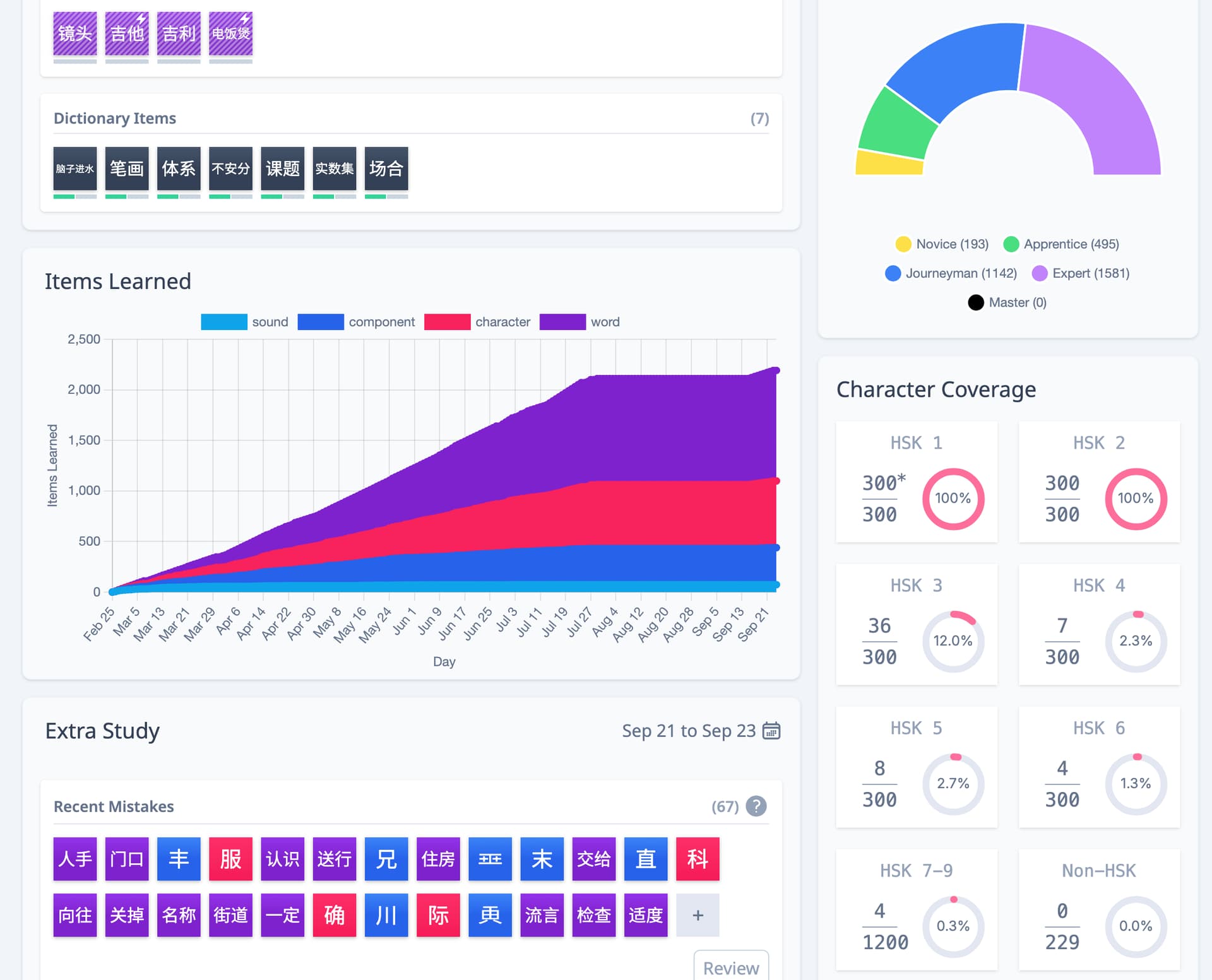
Hello everyone! I have settled back into a routine, only doing 10 characters a day because I am very busy in other areas of my life right now. Here is the state of my dashboard, there is finally a noticeable upward trend on the newest portion of the plot!

I have been slowly coming to the realization that I am not really able to visualize things very clearly in my mind, so I have been working on other ways to form a strong connection with the characters and words I’m learning. The things I’ve found that work for me are all methods of creating an emotional connection with the character, and actually having the components of the character somehow play a role in the direct meaning and pronunciation mnemonic without needing to introduce the Hanzi Movie Method characters sets and locations

One of the problems I had with the Hanzi Movie Method is that there are a lot of characters that end up having very similar locations with similar actors in similar scenarios and they all kind of run together in my head, not to mention the fact that I had a harder time visualizing the components. What I have been doing lately is trying to find some sort of mnemonic connection between the components of the character and the actual pronunciation.

For the tones, I have been trying to connect the characters to certain emotional states. For example, the first tone feels very solid and unwavering, or perhaps it also sounds like someone is singing, so for the character 垃 (lā) for example, I might imagine someone (a guard or something like that, symbolized by the right components) carrying a trash bag to a trash bin and singing a song, “la la la”. Since trash is often in landfills, it makes sense to have the soil component on the left. This system is most effective for phono-semantic characters I have found. The fourth tone to me is like a statement of fact in an english sentence, so I have been connecting fourth tone characters to the literal emotion of resolution and definites. The second tone is questioning, or alternatively it is associated with the idea of a raise to a more energetic state. The shape of the tone mark for the third tone makes me think of something settling in, like a ball reaching the bottom of a valley, and for this reason the third tone characters have been associated with a state of calm, and contentment. I’m sure none of this makes sense, it’s difficult to convey the nuance here but it has been working for me.

Another thing I have been doing is to actually learning characters and words that I could see myself using every day, and that pertain to topics I really care about. It’s a lot easier to make yourself care about learning these characters when they are already connected to ideas that you find interesting and are fun to think about. Plus, if you are more familiar with them beforehand, it allows you to build a stronger emotional connection with the sight and image of the character, and perhaps even give you a better understanding about the philosophy of the language in general, i.e., what components are included in a character about a concept you already know a lot about shows you what parts of that idea or activity that the language itself “chooses” to focus on most.

If you think about the state of your English knowledge, whenever you see a word your brain automatically associates it with some sort of emotional state and concept. I’ve been trying to construct a similar scaffold for Chinese characters. Every character is unique and every character should elicit or incite a unique emotional response and a connection to a cluster of related ideas. Part of this comes from interacting with characters throughout the day, which is why I have labelled just about everything in my house, and part of this comes from the intrinsic definition and shape of the character itself, which is forged and strengthened by the method mentioned above, and repeated exposure to the emotional framework of the characters.

The last thing that I have been doing lately that is worth noting is that I have found a pen pal in China to write to, and I have been incorporating the words that I engage with in these letters and emails into my study sessions by prioritizing them and using the dictionary function a lot, as you can see by the screenshot of my dashboard. This means that my progress on the course is going a little slower, however I’m ok with that because I feel that the parts of the language that I am engaging with are the parts that I really care about and have some sort of connection in my own life, which helps me better associate an emotion and ideas to each word and character. This also gives me a better feel for the kinds of characters and words that are actually important to know in understanding the language, affords me more hands-on experience with grammar, and is actually really interesting to engage with unlike graded readers which I have to usually make myself read.

Learning this language is hard, and I’ve found the best way to truly learn these things and to make them stick is to find a method that works for you and that is unique to you. Blindly following even the best and most well-meaning advice means that you miss out on that rich and important experience of understanding your own cognition and learning biases that will really make things stick and give you insight into your learning patterns long-term. That’s just my thoughts anyway.

All that is to say, I have been focusing much more on quality instead of quantity, and I would say it has provided me with a much-needed fresh and renewed perspective. Thanks for reading! Leave a comment if any of this resonates with you; or don’t! That’s ok too :slight_smile:

3 Likes