As someone who’s just purchased the lifetime subscription, I’m feeling a little annoyed.
I can understand this is a project ran by two guys and I can understand a break or halt on updates but complete radio silence on communication isn’t really acceptable.
Does anyone know what’s going on? Are we ever gonna get any new updates?
To be transparent: I was investigating making a mobile app and got lost in that, and then some personal issues demanded time from this project.
But I’m here! Let me know what sucks/is annoying about HanziHero or what features you’d like to see In fact, I think I could install a discourse plugin that would allow people to vote on what they’d most like to see next…
Inability to easily view/set/manipulate learning order of items (mostly words)
Inability to easily find/tag/deal with with leech cards
Inability to see/enter/learn other alternate pronunciations/meanings
Inability to find/tag/deal with similar conflicting characters/words that continually get mixed up
Inability to find good practise material for your level
My personal preferred solutions:
Remove the current prioritisation system and just add a simple queue system that is checked first when adding new items to learn, if queue is empty then fall back to the current character priority system
Add specialised leech section that let you see and study cards that are regularly failed (where “regularly” is some variation of “card has at least 5 reviews and more than 30% of them are failures”)
Put the dictionary definitions inside the character/word details panel (as in next to Mnemonic, Pronunciation and Meaning sections there is an extra Dictionary section that’s just got the full details for everything). Also add an option in the HH sections to allow you to enter alternate pronunciations/definitions as valid answer (exactly like how you allow Mainland vs Taiwan tones and just show warning) so I can type in hai2 for 还 etc.
Add a new card/test type where you are shown two characters instead of just one and you have to answer all the usual questions for both while they’re side by side (so there are two answer boxes where you must type in both pronunciations or both key words etc). This would run off the Visually Similar section so any character that has a similar entries, once you’ve learn both then you start seeing the comparison cards in the queue. Finally you then let users add their own items to the similar list so they can setup their own comparisons as needed. So I could tag 很 and 浪 and then have the comparison card show them together and be answered simultaneously as 1 “card” in the system that’s full SRS’d as any other item. (And if I then add 狼 as another similar item I get (很 vs 浪), (很 vs 狼) and (浪 vs 狼) as 3x comparison cards etc).
Email DuChinese people and setup a system where you can import your known list of characters from HH into DuChinese and have it spit out their story content ordered by the % of characters you should know based on your HH list. Bonus points if you then let them link back so you can export new characters/words found in DuChinse back into your HH custom queue from item 1 so instantly start studying what you’re reading.
[Edit:] Re-reading this after some of the replies and I now too agree that the custom list order isn’t actually as important of some of the other items below it. My new order is prob just to put my original #1 behind the comparison cards (so 2nd last, only ahead of reading material finder).
Yea I agree with the leech cards ideas.
I would really really really like a way to just do one of the ‘extra practice’ things for word that’s I keep bombing out on. And if I could add my own additional choice words to that list then I’d be golden.
I hate knowing I have words I repeatedly get wrong and I have to wait until they come back around to try again. It’s just too much work to keep track of them manually and it grows my daily receiws when I know that if I just hit them over and over again for a day or so I could get past them.
I’d be happy to just see some more characters added regularly. But the items for visually similar characters and the leech idea above seem indeed very useful.
Yeah, right now HanziHero has no solution for leeches and in general doesn’t have any advanced way to manage cards.
I recall looking into reworking the prioritization because the current system is quite complicated too. The current way prioritization works makes it difficult to support custom reordering which would be nice to support. Having some sort of “upcoming items” view would be cool too.
The “visually similar” characters could be beefed up a lot too compared to what it is. Our current lists aren’t complete in any sense of the word. Alternate pronunciations has been an issue too.
Thanks for all the feedback! And please don’t hesitate to remind me or ping about other issues, or bump old threads
Happy to hear from you @phil. I’ve been grateful to HanziHero as a more straightforward, streamlined, and more affordable take on the SRS-plus-mnemonic system I got from Mandarin Blueprint.
However, I do also have a few frustrations after using HH for several months now:
Too many characters and words are missing common definitions, meaning I type an entirely valid translation, it comes back wrong, and I have to undo, then add the answer to the list myself. I wonder if you could pull data on which items have the most user-added answers as an indication of which ones need some official updating?
The suggested mnemonics are often weak. I say this coming from a lot of time spent with Mandarin Blueprint’s system, which is very effective, and with which HH obviously shares a lot. But a few big aspects MB would help a ton: 1) Each prop (component in this case) is something concrete, so that it can play a clear visual and spatial role in each mnemonic scene. This is a huge memory aid and builds into the second point which is: 2) The scene (as much as possible) uses the actual spatial arrangement of the components in the character. So if we’re learning 摆, we’d have a net vividly thrown over an arrangement of elbows covered in soil, and then maybe a finger is finishing the arrangement from the side. Finally, 3) the target meaning is the clear interpretation of what’s going on, like what I did with 摆 just now. But too often HH does something like, “So Bart makes an ARRANGEMENT to have the pile cleaned up,” which is far too loose and arbitrary. You can take a crazy scene and then randomly associate almost any word with it; that doesn’t help memory.
Not all the mnemonics are weak in the above ways, but many are. I end up having to adjust or create my own, and that’s because I already know the MB approach which is based on what memory champions do. I’m sure it would be a lot of work to go back and update all the mnemonics, but at the very least, it’s well worth being aware of this shortcoming.
I second this! I think the approach you proposed is solid as well!
I think this is not a problem of HH in itself. Yea, some mnemonics are pretty weak but I think you end up naturally develop a system of your own. This is the same “problem” as with WK, where I started creating my own system around lv ~20ish. I don’t think you need to be a memory champion for this method and HH gives a nice system for you to start with.
Maybe not having the strongest mnemonics helps develop your system naturally earlier, but I would make the mnemonics of the early levels especially solid, so as to not crush motivation when you can’t remember vague mnemonics. So maybe that is something to improve on.
update: I’ve started using the end of review summary button that allows you to review the ones you missed. basically i just keep re-reviewing my missed cards until there are none left to review for that day. that way i can see them again immediately. seems to be helping.
I think a mobile app with an offline mode would be nice. I had to use the vacation mode on my last trip, because I was to tired in the evening to do my reviews when I had the hotel wifi and during the day I often had no/bad mobile internet (or you don’t have that much data volume to begin with). If an app would allow you to download the reviews of the day and still do them when- and wherever you want.
I’ve never thought of an offline mode, but this would be great for if you’re on a long commute with little-to-no internet, like the bus, train, airplane, etc. I’m “upvoting” this as a nice-to-have feature!
I think this is part of a larger problem when it comes to leeches, too. To consider the leech problem fully solved we’ll need an answer to when the mnemonic just doesn’t work.
This is something we can do I would be curious about that data honestly. Thanks for the suggestions!
This was one of the workflows I intended with the extra study, that you can queue up again and again at the “Summary” screen the ones you got wrong each session. That + the calendar can let you cover a lot of the “leeches”, but this still isn’t the solution for leeches, I will admit
Yeah, I think in general we have more time to do reviews while on the go, waiting for something, so that’s why I got fixated on making a mobile app with offline mode. The “offline” aspect does add some complexity, but overall I think it’d be cool to have too!
It seems to work well “semi-offline,” I’m often doing reviews in the NYC subway and go in and out of service and it is usually fine, I just lose the audio. So there does appear to be some kind of buffer, since I can continue reviews while I have zero service. But if it is more than a couple of minutes, it says I’ve lost connection. Maybe as a bridge to a fully offline, the “buffer” (idk what you actually have coded on the back end) can just be increased on the web page to save more review responses while mobile app is still being developed.
I hope that makes sense, I’m speaking just from user experience and have no clue what’s going on under the hood.
Extending the “offline” session of the webapp could be viable. I’ve heard some stories regarding the reliability of offline data in Safari among other browsers though where they can “clear” it randomly, or this could all be rumors. I think there are some preventive measures and service workers/other browser capabilities to better hold onto this data, but I’ve not looked into it fully
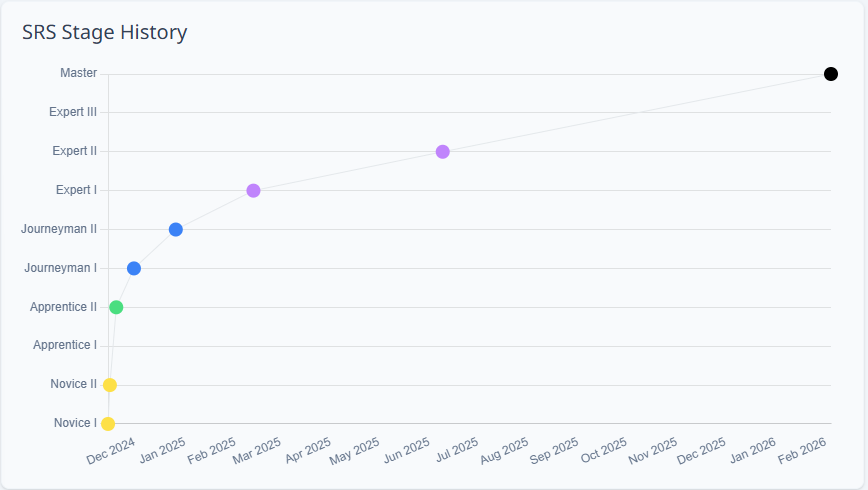
Have way to export data about my learning - date time of my learning, number of new character per week etc. already learned characters, having way to access to this data would be amazing. Even simple csv would be great.
Now days I often struggle to copy data about my progress in to the LLM tool I am using for creating exercise and this would be amazing to have.
This way, the CSV can remain 1NF while the progress cell could be dynamic. I’m assuming this data is already avaiable given that we can see our progress as a plot anyway like below:
with these kind of data i would be able to do alot… not even speaking about feedback for data analysis - creating proper model you could probably see what kind of characters are hardest for people and maybe tweak mnemonics and other stuff and use it for quantiative feedback

 and in general doesn’t have any advanced way to manage cards.
 I would be curious about that data honestly. Thanks for the suggestions!
 where they can “clear” it randomly, or this could all be rumors. I think there are some preventive measures and service workers/other browser capabilities to better hold onto this data, but I’ve not looked into it fully