Beginner who's unsure of how to proceed

Hello!

I’m new here, and I’d like to say hello. I started using HanziHero so as to learn Simplified Chinese from scratch on 22nd July. Although I’m on holiday now and have more time than usual, I’ve started at a ‘casual’ pace of 5 items a day, though on certain days when I’ve felt optimistic, I’ve increased this limit a bit. The result is that up to now, I’ve learnt 208 items. I like HanziHero, and I’m even considering the possibility of paying for a subscription. But I have some qualms about it, and I’d like to ask you who have been here for longer for some advice.

There are three main things that I’m not completely happy with.

  1. I’m more or less good at remembering the meaning of characters and components (well, just today I learnt one I can’t remember to save my life, 么; I suppose it is because I have no idea what ‘muh’ is supposed to be). What I find very, very difficult is remembering the pinyin. It’s not just a matter of remembering the tone, but the whole sound of the word. I learn a new character, and five minutes later I have no idea whether it should be pen2, shui3 or tlang7. And the mnemomic stories don’t seem to help. Most of the times I don’t know the characters that are used, but even when I do, I never seem to remember who was doing what where. I understand this invalidates one of HanziHero’s best advantages for me. I know I could make up my own stories with characters I know but, as I said, I don’t seem to remember the stories anyway.

  2. Some of the words I’ve learnt seem pretty useless when you’re a beginner like me; this is not the biggest of issues for me, but if I ever want to prepare for the HSK exams, I’d rather know that all the time I’m devoting to studying will be useful for the specific HSK level I want to pass. I understand HanziHero does this because they teach you some components, and then they introduce words that are combinations of those components, but I can’t help finding this method a bit erratic.

  3. I’m a bit concerned about this method which teaches you mostly to recognise characters and words, but not much more. I think it’s dangerous for me: I’m one of those weird people who want to learn a language to read and write it, not to speak it. But whenever I learn a new language, I always try not to neglect the speaking and listening parts, though they are extremely difficult for me, because I’d like to learn it well. And I feel HanziHero encourages me to remain in my comfort zone.

Having said all of this (thanks for reading so far!), I’d like to know whether you think I may profit from HanziHero in the long term. As I said first of all, I’m learning very slowly even though I’ve got much more free time now than the rest of the year. So my first approach if I decide to get a subscription might be using it only for reviewing, and paying for single months whenever I foresee I’ll have some days off.

As for fixing point number 3, I suppose I should combine it with some other tools that cover all which HanziHero doesn’t cover. So I’d be grateful if you could suggest which these tools could be. And, in general, any piece of advice will be very welcome.

Thanks a lot!
1 Like

Yeah I’ve said it before on here but HanziHero won’t teach you to read, HH teaches you to recognise the characters. And for that, it’s the best way I’ve personally found. But it’s literally JUST for that. As much as I’d like that to be all you need, as you’ve rightly stated it isn’t.

But if your goals are mostly reading, then I do believe HH combined with DuChinese is a win. Practising reading using all the character you’re learning is a game changer.

Two things I’ve found that relate directly to your issues:

  • I find learning the character for a word I already know how to recognise (usually from CI videos) significantly easier. If you’ve heard shénme 100x times on youtube then linking to it isn’t that big a thing.
  • Seeing the characters outside HH when I’m learning them also makes them “real” somehow. Abstract HH items mean nothing, but getting invested in a DuChinese story that uses 什么 will make a HUGE difference.

For reading, then that’s pretty much all you need (and if want less fiction stories and more news articles for reading practise many people also recommend Chairman’s Bao but I’ve not used it personally). I also like prioritising chars/words I find outside HH as well - the HH list is fine, but no reason not to add things you’re interested in when you want/need them!

If you do want to branch out and not just sit in your comfort zone, other things that have paired very nicely with HH for me are:

  • Using a tutor on iTalki.com to learn/practise pronunciation. I found I couldn’t hear the tones properly until I learnt how to say them - paying someone to make sure I was producing the sounds clearly is once of the best things I’ve spent $$ on.
  • Watching Comprehensible Input with a mouse over dictionar. There are many CI Youtube channels. If you’re starting out LazyChinese beginner playlist, and Xiaonita beginner playlist are decent intro’s, but there are literally hundreds of channels. Great listening practise and the subtitles are always there to practise reading as well if you didn’t hear things properly.

With a few hundred hours off CI and a few hundred characters from HH under my belt I’ve had no issues travelling around China talking to random people and generally navigating around. It works. But it is hard and does take time!

2 Likes

@kaysik, thanks a lot for your detailed message. I’ve had a look at DuChinese, and I think it may be very useful. I like the way you can see the translation of the full sentence and of each individual word at the same time. I’ll have a look at the free trial carefully, to see how it combines with what I’ve already learn on HanziHero, and carry on from there if I see it works.

I’ve also saved the other URLs, and I’ll try to start listening to some real Chinese at the same time, even if I can’t understand much at the beginning. My ear is particularly bad, so I’ll try not to get discouraged soon. I hadn’t thought of using a tutor, and it’s great to know of a website where I can find one that is good.

There’s another question I’ve got. I think that the names HanziHero gives to some components has nothing to do with their meaning, but only with what they look like (也, 工, 文…). You only get to know what they really mean when you see them labelled as characters. Doesn’t this interfere with the words or characters whose meaning is really that? I mean, if you need to say ‘giant’ in Chinese, don’t you end up running the risk of saying 文?

1 Like

At the beginning, maybe. The HH lists do a pretty good job of keeping component meanings relevant. It’s not perfect, but most are correct/match or at least significantly closer than 文 to their actual meaning so you don’t hit this issue that often. 文 is particularly bad.

But with time, the components+mnemonics fall away and you just KNOW the character. The components + mnemonics are only there to anchor it into your memory long enough that exposure takes over. Once you start using the language and the characters/words, the mnemonics fade completely. I didn’t remember at all that 文 was giant in HH, and I would never make that mistake IRL because every time I’ve ever seen 文 it’s some combination of writing/language/culture (e.g. 中文 or 文化). Once it’s like +6 months between seeing the HH card even the HH keywords can fade. Which is not a problem - unless you have an exam you have to pass specifically on the HH item, the goal is never “win HH”, the goal is “learn Chinese”. As long as I know how to use 文 properly, HH’s component/mnemonic/keyword are irrelevant. So long term, this miss-match isn’t a thing and has never caused issues for me (except failing a HH review now and then).

2 Likes

I would suggest you learn pinyin as soon as possible. It is a required prerequisite for learning Mandarin. It’s not hard at all, and much like any other language, you usually learn the phonetic alphabet first. Mandarin is nice because the entire language has a fixed number of possible combinations of initials and finals.

This table demonstrates this well: AllSet Learning Pinyin Chart
You just need to learn how to sound the initals, and how to sound the finals, and then you combine them when you see them in the wild. It’s like hooked on phonics.

Next i would say that HanZi Hero is THE best tool for learning Chinese characters and vocab as fast as possible. I have found that learning Chinese is so much easier if you learn the characters and the words you can make with those characters before you go and try and learn anything else. because i spent years staring at Chinese sentences and had no clue what 2 or 3 of the characters meant or even how to pronounce them and it meant the entire thought was lost to me.

Now that i have a large toolbox of characters and words, thanks to HH, I can easily approach any material that’s trying to teach me grammar points or improve my hearing or reading. It just all becomes approachable.

So I would start thinking of HH as your baseline. The level your character base is it, is the level you can expect to be learning concepts and skills outside of HH. Actually the HSK curriculum is structured exactly like this as well. You learn Level 1 characters, then you learn their words, then you learn grammar concepts using the words. before you learn level 2, you are going to need to learn level 2 characters and words, etc..

Your struggle is not foreign to any of us, we all struggled with the same things you are at the beginning of the Mandarin journey. I’d just recommend you keep adding to your character toolbox, do your reviews daily, and then go expose yourself to more Mandarin outside of HH. After every milestone in HH you’re guaranteed to see an improvement in what you can interact with in the wild.

HH is the quickest and most efficient path to rapid and genuine progress I have come across after trying nearly every tool and resource there is.

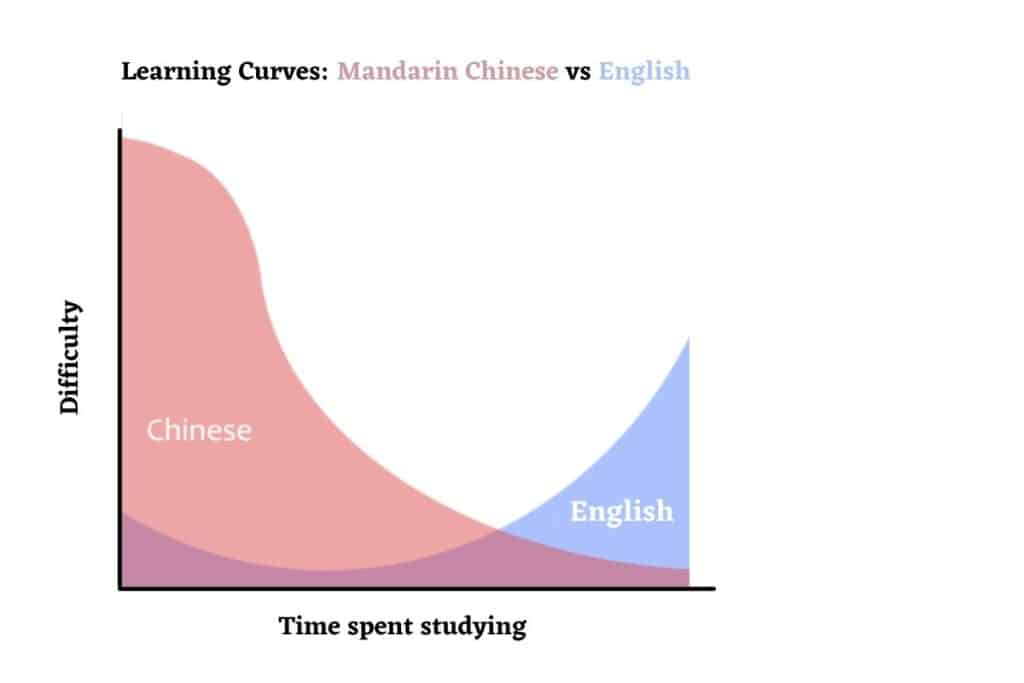
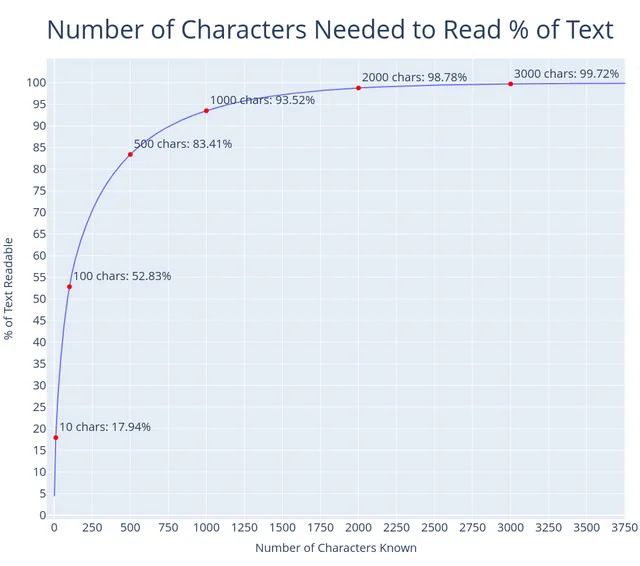
I’ll leave you with two charts that help illustrate the very real concept, that Mandarin is very hard at the beggining, but as your recognition of chracters grows, the learning difficulty rapidly declines. You start to see the patterns in radicals for both meaning and pronunciation. you learn stroke order patterns and the recognize the strokes for writing easily. you’re ear for hearing tones, and your ability to speak the tone combos becomes something you don’t even think about anymore. the grammar was alreadyt he easiest part, but you start to think in the same sentence patterns that made translation so hard at first. It just all gets way easier. I don’t think all languages are this way.